
We are proud to share that Alex Caruso recently delivered a guest lecture to MSc Health and Climate Change students on behalf of Dr Pedro Beltran-Alvarez. The lecture was held at Hull York Medical School and the University of Hull, exploring Quantum Architecture for Enhancing Health & Wellbeing.
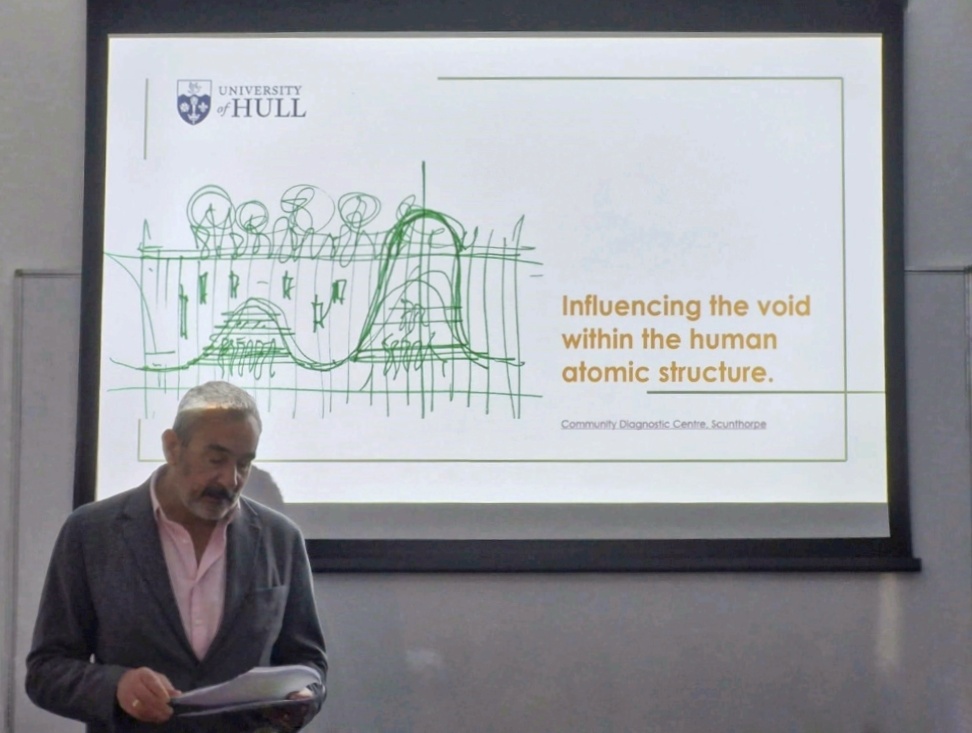
The Connection Between Quantum Physics & Architecture
In his lecture, Alex explored how observation and belief systems, fundamental principles in Quantum Physics, can also shape the way we experience architecture. Much like in quantum experiments, where the observer influences the outcome, architecture has the power to engage, inspire and transform individuals based on how they interact with a space.
Rather than creating spaces that dictate how people should behave, Alex emphasised a holistic, organic design approach — one that encourages choice, interaction and emotional connection. The aim is to design spaces that resonate with users on multiple levels, offering a sense of purpose and enhancing overall wellbeing.
Designing for Wellbeing: Engaging the Senses
At the core of Quantum Architecture is the idea that buildings should not just serve functional needs but actively contribute to mental and physical wellbeing. Through careful design, Alex seeks to create environments that:
Stimulate the senses – offering a rich visual, tactile, and acoustic experience.
Provide a sense of purpose – spaces that go beyond aesthetics to deeply connect with users.
Promote mindfulness and awareness – encouraging observation, reflection, and a sense of belonging.
Foster emotional and cognitive balance – helping to reduce stress and support gracious ageing.
A Multi-Disciplinary Approach to Architecture
To achieve these outcomes, Alex integrates complementary fields, including neuroscience, psychology and wellbeing science, into his architectural practice. He draws inspiration from quantum principles such as complementarity, contextuality, consciousness and connectivity, using them to design spaces that enhance the human experience.
Additionally, in his lecture Alex explored the alchemical process of transformation — Digestion, Distillation, and Calcination — as a metaphor for creating architecture that elevates consciousness and promotes positive change. By balancing rational thought (the mind) with emotion and intuition (the heart), architects can design buildings that truly support the human experience.
Pedro Beltran-Alvarez
Pedro Beltran-Alvarez, Senior Lecturer at Hull York Medical School, co-Director of MSc Health and Climate Change commented:
“Outstanding public speaking and lecturing skills and style! Our students really enjoyed Alessandro’s inspiring vision of holistically designing healthcare spaces for, well, healthier spaces! (it sounds obvious, but it isn’t in practice!). Our MSc Health and Climate Change students found your ability to bring together architecture and design with health, environment, sustainability and climate change simply exemplary and many commented that more practices should be like yours. The participative exercise was very engaging and you led your audience to ‘do’, ‘feel’ and ‘share’ – truly outstanding technique. Thank you for sharing your expertise with us and for being a role model!”

Transforming Lives Through Purpose-Driven Design
Alex’s lecture underscored the importance of applying heart-brain philosophy in architecture. By acknowledging the heart as a second brain, deeply connected to empathy and creativity, he demonstrated how architecture can go beyond mere aesthetics to create meaningful, life-enhancing environments.
Through this approach, ACA’s designs aim to improve health outcomes, reduce stress, support ageing with dignity, and foster social connections — ultimately creating spaces that inspire, heal, and transform lives.
We are incredibly proud of Alex’s work in pushing the boundaries of architectural design and sharing his vision for a more conscious, wellbeing-focused built environment.
SKeep up to date with ACA News!
Frequently Asked Questions
What is Quantum Architecture?
Quantum Architecture is a design philosophy developed by ACA Co-Director Alex Caruso. Drawing inspiration from concepts including complementarity, contextuality, consciousness and connectivity, it explores how light, atmosphere, perception and human interaction influence the way spaces are experienced. It complements established architectural principles by encouraging a more holistic and people-focused approach to design.
What is wellbeing architecture?
Wellbeing architecture places people’s physical, mental and emotional wellbeing at the centre of the design process. It considers how factors such as natural light, acoustics, ventilation, accessibility, materials and connections with nature can affect people’s comfort and experience of a building.
How does architecture influence wellbeing?
Architecture can influence how people feel, behave and interact with their surroundings. Thoughtful spatial planning can help reduce environmental stress, encourage social connection and create more comfortable and supportive places in which to live, work, learn or receive care.
Why is sensory design important?
People experience buildings through sound, sight, touch, and movement. Sensory design considers elements such as colour, texture, lighting, acoustics and spatial transitions to create environments that are easier to understand and more comfortable to use. This can be particularly valuable in healthcare and inclusive settings where people may have very different sensory or cognitive needs.
How does ACA apply Quantum Architecture in practice?
ACA applies the principles of Quantum Architecture alongside established technical, regulatory and evidence-informed design methods. This therefore involves listening carefully to building users, considering how people experience and move through places and exploring how daylight, materials, acoustics, nature and opportunities for social interaction can support comfort and wellbeing.
Related Resources
– Transforming Healing Spaces – Visionary Guest Speaker on Healthcare Design
– Quantum Architecture: An Inspiring Paradigm for Healing Spaces
– Proud Mentor: Alex Caruso Appointed to Prestigious RIBA Future Architects Programme for 2025/26
– ACA Directors Deliver Masterclass on 6 P’s for Growth at Hull University Business School